




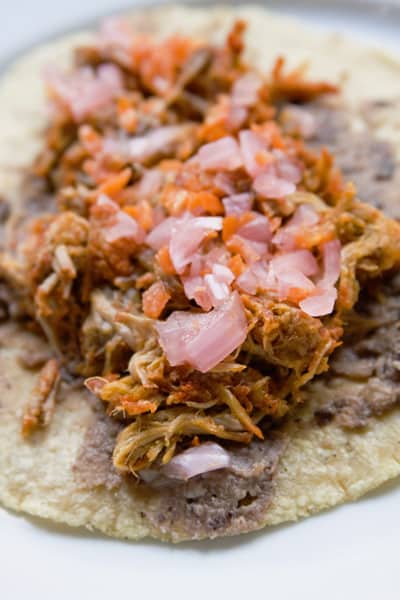
Earlier this summer, I found myself searching every ethnic food aisle and every Mexican grocery store in Chicago for Chata-brand canned Cochinita Pibil. Having had it before, I knew it wasn’t as good as the real thing but I was yearning for that delicious achiote-flavored pork. Sadly, it was nowhere to be found. In a moment of desperation, I even searched the internet to see if I could order it from somewhere—finding out I was going to have to pay nearly $10 for a 14-ounce can, plus shipping.
All I could think about was the last time I’d eaten cochinita pibil in Mexico. After a big Christmas celebration with our extended family in Mexico City, we took a trip to Cuernavaca to ring in the new year with my husband’s parents and sister. We spent our vacation playing Mexico City Monopoly (with properties like Xochimilco and Chapultepec instead of Park Place and Broadway) and endless hours of domino. Laughter and shouts of “tramposo!” could be heard any time it was suspected that José was cheating...which was often, because he always likes to win.
On our way back to Mexico City, we stopped at a Yucatecan restaurant called El Faisán, where my suegros often visit after spending a weekend with friends in Cuernavaca. It was the first time both José and I had been there.
I know if El Faisán wasn’t as authentic as anything you’d eat in Mérida, my family wouldn’t eat there. They suggested I try the queso relleno which had a picadillo-style mixture incorporated into the cheese; it’s a favorite of one of our tias. My cuñada ordered sopa de lima and shared it with me. But what pleased my palate the most was an order of three little tacos de cochinita pibil. In fact, we ended up asking for three orders, and there was a mad scramble to get more than one little taco each. Paired with a tall, ice-cold glass of horchata to drink (another one of my favorite things), I was in little piggy heaven.
José was skeptical when I ambitiously said I was going to make cochinita. “In a regular oven?” he said, “it’s gonna be yucky.” In the Mayan language, "pib" means an underground pit for cooking, and that’s the traditional way to make cochinita pibil. Obviously that would be difficult to accomplish living on the sixth floor of a condo building in downtown Chicago, where we have no backyard. But when all was said and done and he tasted his first little taco, he gave me his standard stamp of approval—two thumbs up—and his blessing to make it again.
RECETA:
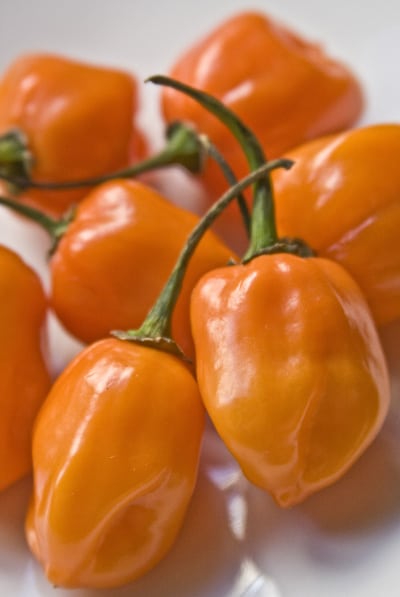
SALSA DE HABANERO Y CEBOLLA
- 5 habanero peppers, roasted and finely chopped
- Juice of ½ an orange
- Juice of 2 limes
- 1 medium red onion, finely chopped
- 2 teaspoon white vinegar
Roast habaneros in a skillet on medium heat until they start to get a few dark spots. Cut top off the pepper and discard stem. Finely dice the habaneros.
Mix the diced habaneros with the chopped onion in a bowl (or directly in the container you intend to store the salsa in, preferably in a glass jar). Pour juices over the habaneros and onions and then add the vinegar. Toss lightly to moisten and refrigerate for at least 4 hours before serving. Keeps refrigerated for about 5 days.
COCHINITA PIBIL
- 3 lbs pork shoulder, cut into large stew-sized chunks
- 2 large hojas de platano (banana leaves; if you can’t find them fresh, you can usually find them in the freezer section with other ethnic foods. My grocery store carries Goya brand frozen banana leaves)
- A roasting pan
- Aluminum foil, preferably heavy duty
Marinade:
- 100 grams achiote paste (one box, also called annato seed paste)
- 1 ½ cups fresh squeezed orange juice
- 2 cups fresh squeezed lime juice
- 4 cloves of garlic, crushed
- A big pinch of salt
- A little freshly ground pepper if desired
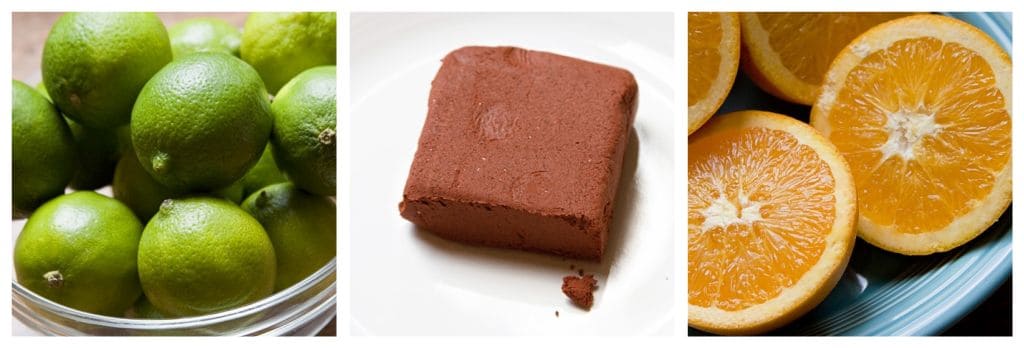
Cut achiote paste (comes in a block) into small chunks. Put into food processor with orange and lime juices to break up the paste and fully incorporate into the juice. Add the garlic, salt & pepper to the juice.
Pour into a gallon-sized Ziploc bag and add the chunks of pork. Remove air and seal the bag. Place the sealed bag in a large bowl and refrigerate overnight (about 12 hours).
In the morning, remove the meat from the juice and reserve the juice. You can put the meat and the juice back into the refrigerator until you’re ready to start cooking.
To prepare the banana leaves, turn your stove burners on low heat and place the leaves over the flames. You need to heat the leaves enough so they are pliable, but you don’t want them to cook and turn brown. The leaves will turn a brighter green when they’re heated through.
Heat the oven to 325 degrees.
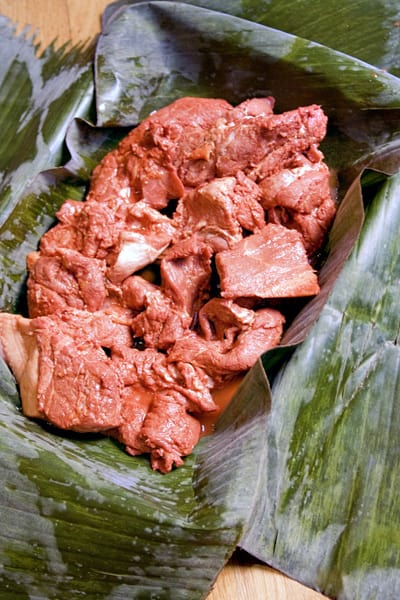
In a roasting pan, place the banana leaves one over the other like a cross. Transfer the meat directly into the pan on top of the banana leaves. Pour about half of the reserved juice over the meat—the juice will help steam the meat so it becomes very tender. Gently fold the banana leaves over the meat, being careful not to rip them but so that the meat is completely enclosed within the banana leaves. Cover the roasting pan tightly with two pieces of foil. It’s important that steam won’t escape, so make sure the foil is really secure.
Place on the middle rack of the oven, once it reaches 325 degrees. Cook for about 2 ½ hours, or until meat is tender enough to shred gently with a fork.
Shred all the meat.
The meat can be served as a main dish itself, with side dishes such as fried plantains, black beans or rice, and as tacos or on panuchos (smaller, fried tortillas, with refried black beans in the middle). If you’re going to make them as tacos, spread refried black beans on the tortilla and then place the meat on top of the beans. Garnish with salsa de habanero y cebolla.
Yields 4 servings (3 tacos each).
17
Steve says
First off I want to say thank you to Maura for putting this blog together. I am a huge fan of Mexican food so this will help me save some money by not eating out all the time 🙂 Every time I look at the pictures my mouth starts to water. Anyways, over labor day weekend I had the pleasure of spending a day with Maura and her husband José to celebrate my birthday. I have been good friends with them for quite some time so I don't think many other lurkers of this blog will get this sort of treatment. We planned on eating some carnitas from a great taqueria in Pilsen in Chicago, but I really didn't know what else we would be "probando." So here is my rundown of what Maura prepared for me that day:
1. When I showed up I was about to eat my hand I was so hungry so to hold me over she warmed up some cochinita pibil she had made and gave me a taco. I have only had this once in 1995 in Uxmal, Mexico, but I couldn't really remember what it tasted like. I made sure to put some salsa de habanero y cebolla on the taco as well. I was a little nervous because I thought the salsa would be way too hot for me, but it actually wasn't hot at all. Just a little to give the taco a little zing. I think I ate the taco in 2.1 seconds. Delicioso!
2. Next we moved on to Empanadas de Platano. I'm not going to say anything about this because I know Maura is going to post about this recipe one day. All I can say is that I ate 10 out of 14 of them and I'd do it again if I had the chance.
3. So after the appetizers we moved onto the main course. Maura heated up the carnitas for our tacos and we used the Salsa Verde Cruda that she posted about earlier to kick the tacos up a notch. I've always wanted to know how to make Salsa Verde. So it was quite a treat helping her make it and then being able to slap it on some carnitas right after. We also made Salsa Verde Cocida, but I didn't get a chance to try that yet.
4. At this point I could barely breath after 1 taco de cochinita pibil, 10 empanadas de platano, and 3-4 tacos de carnitas. Although I said no thanks many times, they both insisted that I eat a small slice of Pastel de Tres Leches. This was picked up at a local cafe. It was very good and I'm glad I was able to force it down.
Thank you Maura and Jose for a great birthday. Your cooking lesson and taste testing was a great experience and I will never forget what I did on my 35th birthday. You both rock.
Maura Hernández says
Steve, thanks so much for leaving your epic comment! So happy we could make your birthday so special. Now I know who I need to call as my main taster next time I make cochinita pibil. 😀